Automatic Packaging Machine: Types, Applications and Buying Guide
Nov 20, 2026
Choosing an automatic packaging machine starts with the finished package, not the highest speed on a specification sheet. The machine must handle your product, produce the required bag format and deliver enough acceptable packages within your available production time.
For sachets and pouches, four equipment options deserve particular attention: small vertical packing machines, large vertical packing machines, multi lane packing machines and premade pouch packing machines. Each addresses a different combination of bag size, filling requirements and production demand.
Use this starting point to narrow your options:
• Evaluate a small vertical packaging machine for compact sachets made from roll film.
• Evaluate a large vertical packaging machine when the bag dimensions or product volume require a larger packaging format.
• Evaluate a multi lane packaging machine when you need several lanes producing the same small package format simultaneously.
• Evaluate a premade pouch packaging machine when your packaging design requires finished bags such as stand up pouches or zipper pouches.
This guide focuses on these four bag packaging options within the Jason Machine product range. Bottle filling, labeling and wrapping equipment are outside its scope. Downstream equipment is considered only where it affects the performance of the packaging line.
What Is an Automatic Packaging Machine for Bags and Pouches?
An automatic bag packaging system combines product dosing or filling with bag handling, sealing and finished package discharge. The first distinction is whether the machine makes the bag from roll film or receives an already manufactured pouch.
Machines That Form Bags from Roll Film
A vertical form fill seal system, commonly called VFFS, forms packaging material into a bag and coordinates filling with sealing and cutting. The exact sequence depends on the machine configuration and bag structure.
Small vertical machines, large vertical machines and the multi lane systems discussed here use roll film. However, they do not necessarily use identical forming parts or sealing arrangements.
These categories also overlap technically. A multi lane machine can use a vertical packaging process. In this guide, the categories describe practical equipment choices rather than four completely separate operating principles.
Machines That Fill Premade Pouches
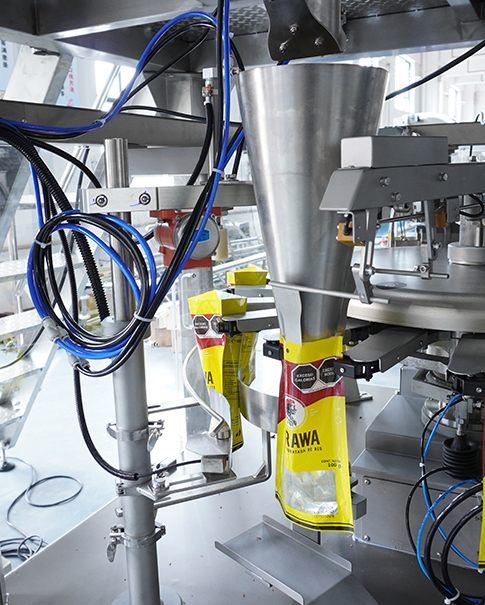
A premade pouch machine starts with bags supplied in their finished shape. It takes a pouch, opens it, fills it and seals the opening before discharge.
This changes the selection questions. Instead of checking only film forming capability, you must verify that the machine can reliably grip and open the actual pouch. Zippers, bag stiffness and the position of the filling opening should all be included in the sample evaluation.
The distinction matters because a machine that forms a gusset pouch from film should not automatically be treated as an alternative to a machine handling a premade zipper pouch.
Which Type of Packaging Machine Fits Your Requirements?
Select the packaging process first. Then compare the available configurations against your bag dimensions, product characteristics and required output.
Machine type
Packaging need to evaluate
Relevant bag formats
Main selection checks
Small vertical packing machine
Small portions packed from roll film
Back seal sachets, three side seal sachets and four side seal sachets, depending on configuration
Bag dimensions, filling range, film width and sealing arrangement
Large vertical packing machine
Larger bags or greater filling volume
Pillow pouches and gusset pouches (in the referenced granule or powder models)
Product volume, forming dimensions, dosing capacity and installation space
Multi lane packing machine
Multi lane packing machine
Parallel production of a consistent small package format
Stick packs or sachets with the specified sealing structure Lane count, film layout, dosing consistency and total acceptable output
Doypack packing machine
Filling bags that already have the required retail format
Stand up pouches, zipper pouches, mylar pouches and other confirmed premade designs
Bag handling, opening reliability, filling access and sealing space
Bag formats shown across a product range are not a promise that one machine can produce every format without modification. Confirm each required bag against the proposed configuration.
When to Choose a Small Vertical Packing Machine
A small vertical packing machine is worth evaluating when your product fits a compact sachet and the required output can be achieved on a single production lane.
The JS-280A granule packing machine and JS-280C powder packing machine use the same base packaging machine. According to the specifications confirmed by Jason Machine, both models have a packaging speed of 30 to 60 bags per minute and a filling range of 4 to 300 ml, specified by volume rather than weight.
The supported bag width depends on the sealing format. Three side seal bags can be 30 to 130 mm wide while back seal bags can be 30 to 140 mm wide. Both formats support a bag length of 30 to 170 mm.
Use these figures to shortlist equipment, not to predict production without testing. Ask whether your exact product and bag dimensions can achieve the required output together.
A small machine should not be selected only because a business is new. It may also suit an established producer with a dedicated small package application. The deciding factors are the packaging requirements and available production time.
When to Choose a Large Vertical Packing Machine
A large vertical packaging machine should be evaluated when the required bag dimensions or filling volume exceed the practical range of a smaller system.
The referenced large vertical granule packing machine page lists the following configurations:
Model
Published filling range
Published bag width
Published packaging speed
420AZ
100 to 1500 g
60 to 200 mm
30 to 60 bags per minute
520AZ
150 to 2000 g
60 to 250 mm
30 to 60 bags per minute
These are manufacturer specifications, not the results of a comparative production trial. The largest filling weight and highest speed should not be assumed to occur simultaneously.
Within this machine range, larger models support higher fill weights and wider packaging film.
When to Choose a Multi Lane Packing Machine
A multi lane packing machine is a candidate when a consistent small package format must be produced on several lanes at the same time.
The four lane granule stick pack configuration lists four lanes and 20 to 50 cycles per minute. Its specified bag width is 15 to 45 mm and bag length is 50 to 160 mm.
The number of lanes is only part of the selection. Ask the supplier to confirm how the required bag width fits the film layout and whether the proposed dosing system can supply every lane consistently.
Also distinguish the bag structures. A back seal stick pack configuration should not be assumed to produce four side seal sachets using the same forming and sealing parts.
For production with frequent format changes, request a clear changeover plan. Adjusting bag length, changing bag width and changing the sealing structure are different tasks. A touchscreen setting alone does not prove that all three changes are possible.
When to Choose a Premade Pouch Packing Machine
A premade pouch packing machine is a logical starting point when the finished packaging design has already been chosen and will be supplied as an empty pouch.
The JS-200YZD granule pouch packing machine lists a filling range of 50 to 1000 g, a bag width of 70 to 180 mm and a maximum bag length of 260 mm. Its published speed is up to 60 bags per minute.
These figures still require confirmation with the actual pouch. A suitable width does not establish that the machine can open the zipper, support the bag and fill it without contaminating the sealing area.
Treat special formats as separate configuration questions. If a product page lists spout pouches, confirm whether the proposed process fills through an open bag mouth or through the spout. Do not assume that spout installation or cap tightening is included.
How Do Bag Shape and Packaging Material Affect Selection?
The finished bag is an engineering input. A photograph helps communicate appearance, but an approved drawing and physical sample provide a stronger basis for equipment selection.
Define the Bag Structure Clearly
A useful bag specification identifies the sealing arrangement, finished dimensions and opening features.
For a small sachet, state whether you require a back seal, three side seals or four side seals. For a stick pack, identify the required cutting style and whether rounded corners or another special shape are needed.
For larger packaging, distinguish a pillow pouch with gussets from a premade stand up pouch. If a zipper is required, specify its position and how the bag will be supplied to the machine.
Avoid relying on a broad description such as “standing bag.” Similar appearances can involve different bag constructions and machine requirements.
Check Usable Space as Well as External Dimensions
A bag must provide enough space for the product and the required sealing area. Net weight alone does not define that space.
Provide the actual product sample so the supplier can assess how it occupies the proposed bag. Confirm the filled appearance and seal position rather than approving a bag solely because its outer dimensions fall within the machine specification.
Record bag width, bag length, seal width and any bottom or side gusset dimensions. Use the same dimension definitions in the bag drawing and machine quotation.
Confirm the Packaging Material
For roll film, provide the material structure, thickness, roll width and print registration requirements. For premade bags, provide samples with the intended material, zipper and opening condition.
Do not apply one film width calculation to every bag format. Ask the equipment supplier and packaging material supplier to confirm the film layout, sealing allowances and cutting arrangement together.
Material names on a product page are useful starting information. The actual film or pouch should still be included in the trial used to approve the configuration.
Which Machine and Filling System Suit Your Product?
Product names help identify the application, but the filling system must be selected around the material that will actually pass through it.
Granules Such as Sugar, Coffee Granules and Seeds
For granular products, provide information about particle size, flow behavior, bulk density and acceptable product damage. If the product is a mixture, include the actual mixture in the sample evaluation.
Ask the supplier to identify the proposed dosing method and explain how it will be checked at the required fill weight. Do not infer the dosing arrangement from the packaging machine category alone.
The same broad product group can lead to different equipment choices. Sugar in small sachets may lead to a small vertical or multi lane configuration. Grain in a larger pillow pouch may lead to a large vertical machine. Nuts in a premade zipper pouch require a different bag handling process.
Powders Such as Coffee Powder, Milk Powder and Spices
Powder trials should examine both dosing and sealing. Ask the supplier to demonstrate how the selected system handles the actual powder and to inspect finished packs for material trapped in the seal.
The product range includes multi lane powder configurations described as using auger dosing. The proposed auger and feeding arrangement should be identified in the quotation rather than treated as a generic solution for every powder.
Include any known dusting, clumping or flow problems in the requirement sheet. If the formulation or fill weight will change, request confirmation of the adjustment range and any replacement parts required.
Liquids and Pastes Such as Sauces, Gels and Lotions
For liquids and pastes, provide viscosity information at the intended filling temperature together with the target volume and any relevant product characteristics.
The published twin lane liquid sachet packing machine states that pump selection depends on viscosity, flow properties and filling requirements. It also calls for product sample confirmation before the final configuration is selected.
Ask the trial operator to check for dripping, stringing, foaming and contamination around the sealing area where these issues are relevant to your product. A machine intended for liquid sachets should not automatically be described as suitable for every paste or as an aseptic filling system.
Match the Application to the Packaging Goal
Packaging requirement
Equipment to evaluate
Main trial question
Sugar or salt in small sachets
Small vertical or multi lane packing machine
Can the selected format meet the required acceptable output?
Coffee powder or seasoning powder in small packs
Small vertical powder or multi lane powder packing machine
Are dosing and sealing consistent with the actual powder?
Grain or snacks in pillow pouches
Large vertical packing machine
Can feeding, filling and sealing keep pace without unacceptable product damage?
Nuts or oats in premade zipper pouches
Premade pouch packing machine
Can the actual bags be opened, filled and sealed reliably?
Sauce or lotion in four side seal sachets
Appropriate liquid sachet configuration
Does the selected pump and filling arrangement control the actual product adequately?
These are selection scenarios, not customer case studies. Final suitability depends on the specific configuration and trial results.
How Do You Calculate the Packaging Capacity You Actually Need?
Useful packaging machine capacity means acceptable packages produced over a defined period. It is not simply the highest number shown on the control screen.
Start with Required Acceptable Output
Use the following calculation:
Required acceptable bags per minute = required acceptable bags ÷ production minutes allocated to the order.
State clearly what the time allowance includes. If cleaning and changeovers have already been removed from the available production time, do not deduct the same losses again in another efficiency calculation.
For products sold in different pack sizes, also compare weight output:
Kilograms per hour = acceptable bags per minute × net weight per bag in grams × 60 ÷ 1000.
This converts units. It does not prove that a machine can sustain the calculated output with the proposed product.
Convert Multi Lane Cycles into Total Bags
Use this relationship when the cycle definition is confirmed:
Theoretical bags per minute = active lanes × cycles per minute × bags produced per lane per cycle.
For the four lane granule configuration listed at 20 to 50 cycles per minute, the theoretical total is 80 to 200 bags per minute if all four lanes operate and each lane produces one bag per cycle.
That calculation excludes rejected bags and downtime. It is not a production acceptance result.
Read the units carefully. The twin lane liquid product page uses cuts per minute rather than cycles per minute. Confirm how cutting relates to finished bag discharge before converting that figure into output.
Separate Catalogue Speed from Sustained Production
Ask for three different figures:
1. The published machine speed range.
2. The speed demonstrated with your product and packaging material.
3. The acceptable output achieved over the agreed test period.
The test record should include the configuration, product, fill quantity, bag dimensions and material. It should also show total packages, acceptable packages and stoppages.
For multi lane equipment, request results by lane. A total output figure or overall average fill weight can conceal a problem affecting only one lane.
Check the Complete Line
Confirm whether product supply, dosing, inspection and downstream handling can support the packaging output.
If the project includes a checkweigher or cartoning equipment, include those interfaces in the capacity review. Require the quotation to distinguish packaging machine performance from complete line performance.
Choose any additional capacity allowance from your production plan and trial evidence. A universal percentage cannot account for every combination of product changes, cleaning requirements and operating conditions.
What Should You Check Before Buying?
A useful quotation explains what the machine will produce, under which conditions it will be evaluated and what equipment is included.
Prepare One Requirement Sheet for Every Supplier
Provide the same information to each supplier:
• Product description and representative samples.
• Bag sample or drawing with finished dimensions.
• Target net weight or filling volume.
• Film specification or premade pouch details.
• Required acceptable output per minute or per shift.
• Product variants and expected changeover frequency.
• Available floor space, access height and utility conditions.
• Required inspection equipment and downstream connections.
This makes proposals easier to compare and reduces the risk of receiving different configurations under similar machine names.
Compare Changeover and Cleaning Requirements
Ask what happens when you change bag length, bag width, fill quantity or product. Identify which changes involve settings and which require parts or tools.
Request a demonstration of cleaning and access to product contact components. If a changeover time is quoted, ask which starting and finishing conditions were used to measure it.
Do not extend one demonstrated changeover time to every product in your production plan.
Compare Total Operating Cost
Separate the purchase price from operating costs. The quotation should identify the packaging machine, dosing system, feeding equipment, format parts and agreed services.
For operation, compare packaging material use, product loss, labor, energy, maintenance and time lost during cleaning or changeovers.
Neither roll film nor premade pouches should be declared the cheaper choice without comparing the actual packaging requirement. A cost comparison is meaningful only when both proposals produce the required package and meet the agreed production target.
Verify Service and Supply Responsibilities
Confirm who supplies the equipment and who is responsible for integration, installation and training. Obtain written details of warranty coverage, wear parts, spare parts and support arrangements.
When reviewing certificates or test documents, check that they apply to the proposed equipment and project. A material description alone does not establish complete machine compliance.
Agree on the response if the equipment does not meet the acceptance criteria. Resolving this before ordering is more useful than relying on a general promise of reliable performance.
How Should You Validate the Machine Before Delivery?
A factory acceptance test (FAT) should turn the purchase specification into observable results. Agree on the test method and acceptance criteria before the test begins.
Use the intended product and packaging material wherever possible. If a substitute is necessary, record the difference and identify which conclusions remain unconfirmed.
Test area
Evidence to record
Basis for acceptance
Filling quantity
Individual results, sample count, measuring equipment and results by lane where applicable
Agreed limits and applicable product requirements
Acceptable output
Test duration, total packages, accepted packages and stoppage records
Required output under the agreed conditions
Seal performance
Inspection results and relevant strength or leakage test records
Approved package specification and suitable test methods
Bag dimensions and cutting
Measured dimensions, print position and cut appearance
Approved drawing and sample
Changeover and cleaning
Actual steps, required parts and measured time
Agreed product and format changes
Abnormal operation
Observed response to relevant feeding or bag handling problems
Functions included in the approved configuration
Agree on How Net Contents Will Be Verified
Define the filling target, sampling plan and acceptance limits before testing. A machine specification alone is not a finished package compliance assessment.
For products entering the United States, NIST Handbook 133, 2026 edition provides procedural guidance for checking net content declarations on packaged goods. It is a jurisdiction specific reference, not a universal machine tolerance. Confirm the applicable requirements for the destination market with a qualified specialist.
Treat Seal Strength and Leakage as Different Questions
A seal strength result and a leakage result provide different information. Do not use one as an automatic substitute for the other.
ASTM F88/F88M addresses seal strength in flexible barrier materials. ASTM F2096 addresses gross leak detection through internal pressurization.
These references identify different types of evaluation. They do not establish one universal acceptance limit for every pouch. A qualified testing specialist should confirm the appropriate method, edition and application limits before either is used in the acceptance plan.
Passing a selected test also does not mean that the packaging machine has received a general certification under that test method.
Confirm Performance at the Installation Site
A site acceptance test (SAT) should verify the agreed performance after installation using the actual utilities, product supply and downstream connections.
Include operator training and the agreed handover documents in the project plan. These may include operating instructions, maintenance information, approved settings and spare parts lists.
Keep the factory and site records tied to the same approved configuration. Any changes made between the two tests should be documented.
Frequently Asked Questions
1. What Is the Difference Between a Small and a Large Vertical Packaging Machine?
Compare their bag dimensions, film width, filling volume and configuration. There is no single weight boundary used in this guide to define every small or large machine. A larger machine may accommodate a larger package without having a higher maximum bag speed.
2. When Should I Choose a Multi Lane Machine Instead of a Single Lane Machine?
Evaluate multiple lanes when one lane cannot supply the required acceptable quantity within the available production time. Confirm the bag format, film layout and dosing requirements before selecting a lane count. Include changeover needs in the comparison.
3. Can One Machine Produce Stick Packs and Four Side Seal Sachets?
That depends on its forming, sealing and cutting arrangements. A product range that includes both formats does not prove that one configuration can switch between them without mechanical changes. Request written confirmation for each required format.
4. Can a Vertical Machine Produce Zipper Stand Up Pouches?
No. The vertical packaging machines covered in this guide cannot produce zipper stand up pouches. For this bag format, use a premade pouch packing machine to fill and seal premade zipper pouches.
5. How Do I Calculate Multi Lane Output?
Multiply active lanes by cycles per minute and bags produced per lane per cycle. Then confirm actual acceptable output through a production trial. Check the original speed unit because cuts per minute and cycles per minute are not automatically interchangeable.
6. Can One Filling System Handle Powders, Granules and Liquids?
Do not assume it can. Ask the supplier to identify the dosing or pumping arrangement for each product. Changing the material may require a different filling system or additional components even when the packaging process appears similar.
7. What Affects the Cost of an Automatic Packaging Machine?
The equipment configuration, dosing system, bag format, format parts and service scope affect the proposal. Compare these separately from operating costs such as packaging material, product loss, cleaning and maintenance. Request a quotation based on a complete requirement sheet.
8. What Should I Request Before Placing an Order?
Request confirmation of the proposed configuration, approved bag samples, agreed acceptance criteria and a test plan using your product and packaging material. Establish the required evidence for filling quantity, seal performance and sustained acceptable output before the purchase is finalized.
Request a Packaging Solution from Jason Machine
The right machine is the one that can produce your required package consistently under agreed production conditions. Begin with the bag and product, select a suitable filling and packaging process and use testing to verify the final configuration.
To discuss a project with Jason Machine, prepare your product details, bag sample or drawing, target fill quantity and required output. Include the packaging material specification and any planned product or format changes.
Contact the team with these details to discuss an equipment configuration that can be evaluated against your packaging requirements.